

Free Clonazepam Discount Coupon
Print your free Clonazepam coupon below and bring it into any of our 68,000 participating pharmacies including: Walgreens, CVS Pharmacy, Walmart Pharmacy, Rite Aid, Kroger, Kmart Pharmacy, and Safeway. This Clonazepam coupon can help you save up to 90% on your medication costs! This pharmacy coupon is pre-activated, can be used immediately, and has no membership fees. Our Patient Assistance Program is completely free and open to everyone.
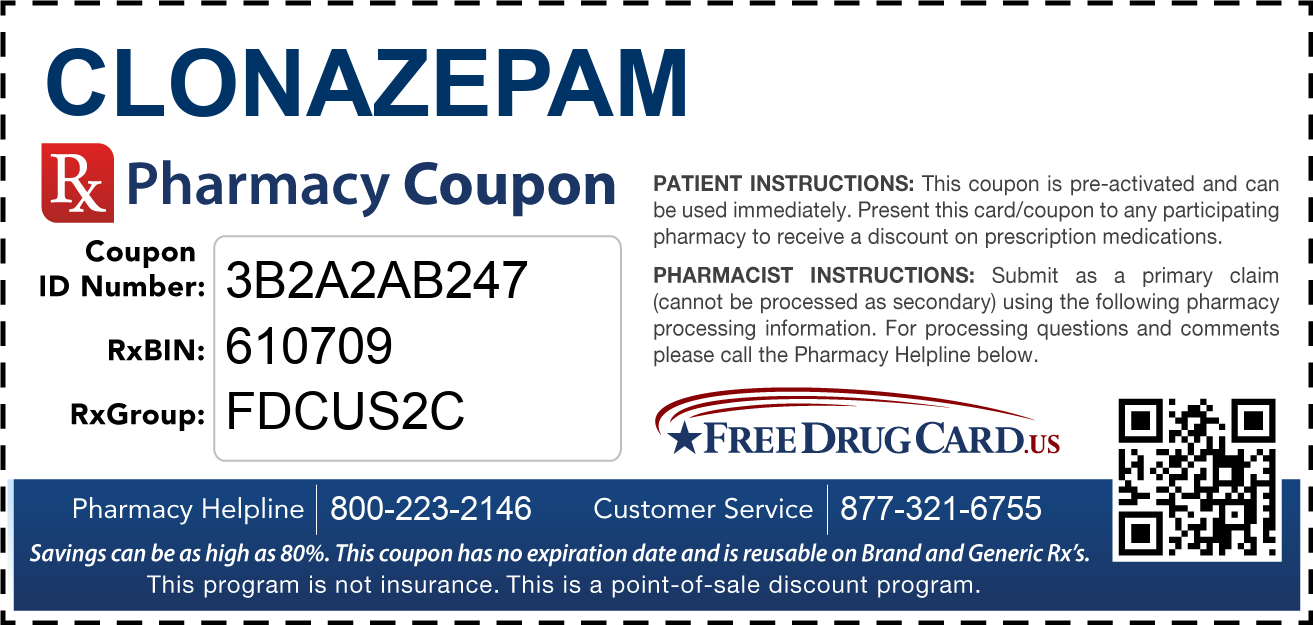
 PRINT COUPON
 TEXT COUPON
 EMAIL COUPON
SAVE COUPON
EMAIL COUPON
SAVE COUPON
Send this coupon as a text message to your cell phone:
Before you text your coupon, Like us on Facebook!
Send this coupon as an email to your friends and family:
Before you email your coupon, Like us on Facebook!
STEP 1: Print or save your free drug coupon.
STEP 2: Bring it to your local pharmacy.
STEP 3: Save up to 90% on your prescriptions!
Clonazepam Drug Information
- Why
- How
- Other Uses
- Precautions
- Special Dietary
- If I Forget
- Side Effects
- Storage Conditions
- Overdose
- Other Information
- Brand Names
Why is this medication prescribed?
Clonazepam is used alone or in combination with other medications to control certain types of seizures. It is also used to relieve panic attacks (sudden, unexpected attacks of extreme fear and worry about these attacks). Clonazepam is in a class of medications called benzodiazepines. It works by decreasing abnormal electrical activity in the brain.
How should this medicine be used?
Clonazepam comes as a tablet and an orally disintegrating tablet (tablet that dissolves quickly in the mouth) to take by mouth. It usually is taken one to three times a day with or without food. Take clonazepam at around the same time(s) every day. Follow the directions on your prescription label carefully, and ask your doctor or pharmacist to explain any part you do not understand.
Do not try to push the orally disintegrating tablet through the foil. Instead, use dry hands to peel back the foil packaging. Immediately take out the tablet and place it in your mouth. The tablet will quickly dissolve and can be swallowed with or without liquid.
Your doctor will probably start you on a low dose of clonazepam and gradually increase your dose, not more often than once every 3 days.
Clonazepam can be habit-forming. Do not take a larger dose, take it more often, or take it for a longer period of time or in a different way than prescribed by your doctor. Take clonazepam exactly as directed. Do not take more or less of it or take it more often than prescribed by your doctor.
Clonazepam may help control your condition, but will not cure it. It may take a few weeks or longer before you feel the full benefit of clonazepam. Continue to take clonazepam even if you feel well. Do not stop taking clonazepam without talking to your doctor, even if you experience side effects such as unusual changes in behavior or mood, If you suddenly stop taking clonazepam, you may experience withdrawal symptoms such as new or worsening seizures, hallucinating (seeing things or hearing voices that do not exist), changes in behavior, sweating, uncontrollable shaking of a part of your body, stomach or muscle cramps, anxiety, or difficulty falling asleep or staying asleep. Your doctor will probably decrease your dose gradually.
Other uses for this medicine
Clonazepam is also used to treat symptoms of akathisia (restlessness and a need for constant movement) that may occur as a side effect of treatment with antipsychotic medications (medications for mental illness) and to treat acute catatonic reactions (state in which a person does not move or speak at all or moves or speaks abnormally). Talk to your doctor about the possible risks of using this medication for your condition.
This medication may be prescribed for other uses; ask your doctor or pharmacist for more information.
What special precautions should I follow?
Before taking clonazepam,
- tell your doctor and pharmacist if you are allergic to clonazepam, other benzodiazepines such as alprazolam (Xanax), chlordiazepoxide (Librium, in Limbitrol), clorazepate (Gen-Xene, Tranxene), diazepam (Valium), estazolam, flurazepam (Dalmane), lorazepam (Ativan), midazolam (Versed), oxazepam, temazepam (Restoril), triazolam (Halcion), or any other medications.
- tell your doctor and pharmacist what other prescription and nonprescription medications, vitamins, and nutritional supplements you are taking or plan to take. Be sure to mention any of the following: amiodarone (Cordarone, Pacerone); certain antibiotics such as clarithromycin (Biaxin, in Prevpac), erythromycin (Erythrocin, E-mycin), and troleandomycin (TAO) (not available in the US); antidepressants; certain antifungal medications such as itraconazole (Sporanox) and ketoconazole (Nizoral); antihistamines; certain calcium channel blockers such as diltiazem (Cardizem, Dilacor, Tiazac, others) and verapamil (Calan, Isoptin, Verelan); cimetidine (Tagamet); HIV protease inhibitors including indinavir (Crixivan), nelfinavir (Viracept), and ritonavir (Norvir, in Kaletra); medications for anxiety, colds or allergies, mental illness, or pain; other medications for seizures such as carbamazepine (Tegretol), phenobarbital (Luminal, Solfoton), phenytoin (Dilantin), or valproic acid (Depakene, Depakote); muscle relaxants; nefazodone; rifampin (Rifadin, Rimactane); sedatives; certain selective serotonin reuptake inhibitors (SSRIs) such as fluvoxamine (Luvox); other sleeping pills; and tranquilizers. Your doctor may need to change the doses of your medications or monitor you carefully for side effects.
- tell your doctor what herbal products you are taking, especially St. John's wort.
- tell your doctor if you have or have ever had glaucoma (increased pressure in the eye that may cause vision loss) or liver disease. Your doctor may tell you not to take clonazepam.
- tell your doctor if you drink or have ever drunk large amounts of alcohol, use or have ever used street drugs or have overused prescription medications. Also tell your doctor if you have or have ever had lung or kidney disease.
- tell your doctor if you are pregnant, plan to become pregnant, or are breast-feeding. Clonazepam may harm the fetus. If you become pregnant while taking clonazepam, call your doctor.
- talk to your doctor about the risks and benefits of taking this medication if you are 65 years of age or older. Older adults should receive low doses of clonazepam because higher doses may not work better and may cause serious side effects.
- if you are having surgery, including dental surgery, tell the doctor or dentist that you are taking clonazepam.
- you should know that this medication may make you drowsy. Do not drive a car or operate machinery until you know how this medication affects you.
- talk to your doctor about the safe use of alcohol during your treatment with clonazepam.
- you should know that your mental health may change in unexpected ways, and you may become suicidal ( thinking about harming or killing yourself or planning or trying to do so) while you are taking clonazepam for the treatment of epilepsy, mental illness, or other conditions. A small number of adults and children 5 years of age and older (about 1 in 500 people) who took antiepileptics such as clonazepam to treat various conditions during clinical studies became suicidal during their treatment. Some of these people developed suicidal thoughts and behavior as early as one week after they started taking the medication. There is a risk that you may experience changes in your mental health if you take an antiepileptic medication such as clonazepam, but there may also be a risk that you will experience changes in your mental health if your condition is not treated. You and your doctor will decide whether the risks of taking an antiepileptic medication are greater than the risks of not taking the medication. You, your family, or your caregiver should call your doctor right away if you experience any of the following symptoms: panic attacks; agitation or restlessness; new or worsening irritability, anxiety, or depression; acting on dangerous impulses; difficulty falling or staying asleep; aggressive, angry, or violent behavior; mania (frenzied, abnormally excited mood), talking or thinking about wanting to hurt yourself or end your life, withdrawing from friends and family; preoccupation with death and dying, giving away prized possessions, or any other unusual changes in behavior or mood. Be sure that your family or caregiver knows which symptoms may be serious so they can call the doctor if you are unable to seek treatment on your own.
What special dietary instructions should I follow?
Talk to your doctor about eating grapefruit and drinking grapefruit juice while taking this medicine.
What should I do if I forget a dose?
Take the missed dose as soon as you remember it. However, if it is almost time for the next dose, skip the missed dose and continue your regular dosing schedule. Do not take a double dose to make up for a missed one.
What side effects can this medication cause?
Clonazepam may cause side effects. Tell your doctor if any of these symptoms are severe or do not go away:
- drowsiness
- dizziness
- unsteadiness
- problems with coordination
- difficulty thinking or remembering
- increased saliva
- muscle or joint pain
- frequent urination
- blurred vision
- changes in sex drive or ability
Some side effects can be serious. If you experience any of these symptoms call your doctor immediately:
- rash
- hives
- swelling of the eyes, face, lips, tongue, or throat
- difficulty breathing or swallowing
- hoarseness
- difficulty breathing
If you experience a serious side effect, you or your doctor may send a report to the Food and Drug Administration's (FDA) MedWatch Adverse Event Reporting program online [at http://www.fda.gov/Safety/MedWatch] or by phone [1-800-332-1088].
What storage conditions are needed for this medicine?
Keep this medication in the container it came in, tightly closed, and out of reach of children. Store it at room temperature and away from excess heat and moisture (not in the bathroom). Throw away any medication that is outdated or no longer needed. Talk to your pharmacist about the proper disposal of your medication.
In case of emergency/overdose
In case of overdose, call your local poison control center at 1-800-222-1222. If the victim has collapsed or is not breathing, call local emergency services at 911.
Symptoms of overdose may include:
- drowsiness
- confusion
- coma (loss of consciousness for a period of time)
What other information should I know?
Keep all appointments with your doctor and the laboratory. Your doctor will order certain lab tests to check your response to clonazepam.
Do not let anyone else take your medication. Clonazepam is a controlled substance. Prescriptions may be refilled only a limited number of times; ask your pharmacist if you have any questions.
It is important for you to keep a written list of all of the prescription and nonprescription (over-the-counter) medicines you are taking, as well as any products such as vitamins, minerals, or other dietary supplements. You should bring this list with you each time you visit a doctor or if you are admitted to a hospital. It is also important information to carry with you in case of emergencies.
Brand names of combination products
- Klonopin®
FreeDrugCard.us is a proud supporter of Children's Miracle Network

A donation will be made to your local CMN hospital each time a prescription is processed using this prescription coupon.


















This Coupon is Good for the Following Anxiety and Panic Disorder Prescriptions:
Clonazepam
- CLONAZEP ODT TAB 0.25MG
- CLONAZEP ODT TAB 0.5MG
- CLONAZEP ODT TAB 1MG
- CLONAZEPAM TAB 0.5MG
- CLONAZEPAM TAB 1MG
- CLONAZEPAM TAB 2MG