

Free Vitamin D Discount Coupon
Print your free Vitamin D coupon below and bring it into any of our 68,000 participating pharmacies including: Walgreens, CVS Pharmacy, Walmart Pharmacy, Rite Aid, Kroger, Kmart Pharmacy, and Safeway. This Vitamin D coupon can help you save up to 90% on your medication costs! This pharmacy coupon is pre-activated, can be used immediately, and has no membership fees. Our Patient Assistance Program is completely free and open to everyone.
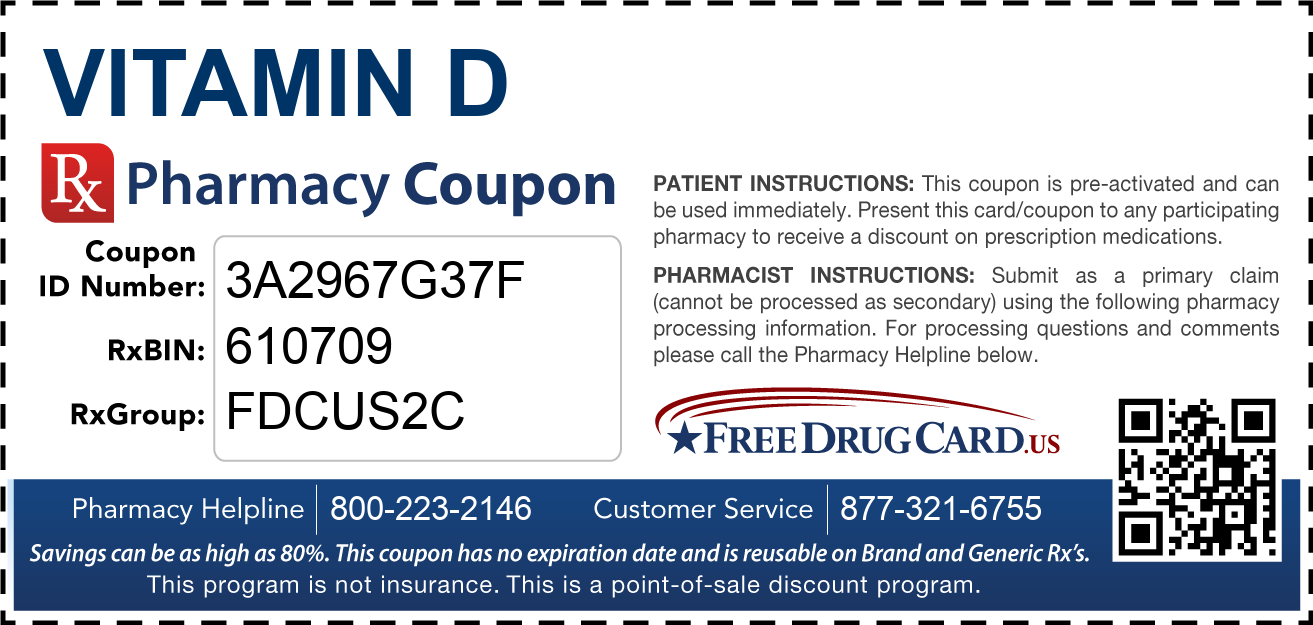
 PRINT COUPON
 TEXT COUPON
 EMAIL COUPON
SAVE COUPON
EMAIL COUPON
SAVE COUPON
Send this coupon as a text message to your cell phone:
Before you text your coupon, Like us on Facebook!
Send this coupon as an email to your friends and family:
Before you email your coupon, Like us on Facebook!
STEP 1: Print or save your free drug coupon.
STEP 2: Bring it to your local pharmacy.
STEP 3: Save up to 90% on your prescriptions!
Vitamin-D Drug Information
- What is Vitamin D?
- How Much?
- What Foods?
- From the Sun?
- What Kinds?
- Getting Enough?
- Effects
- Interactions
What is vitamin D and what does it do?
Vitamin D is a nutrient found in some foods that is needed for health and to maintain strong bones. It does so by helping the body absorb calcium (one of bone's main building blocks) from food and supplements. People who get too little vitamin D may develop soft, thin, and brittle bones, a condition known as rickets in children and osteomalacia in adults.
Vitamin D is important to the body in many other ways as well. Muscles need it to move, for example, nerves need it to carry messages between the brain and every body part, and the immune system needs vitamin D to fight off invading bacteria and viruses. Together with calcium, vitamin D also helps protect older adults from osteoporosis. Vitamin D is found in cells throughout the body.
How much vitamin D do I need?
The amount of vitamin D you need each day depends on your age. Average daily recommended amounts from the Food and Nutrition Board (a national group of experts) for different ages are listed below in International Units (IU):
- Birth to 12 months=400 IU
- Children 1–13 years=600 IU
- Teens 14–18 years=600 IU
- Adults 19–70 years=600 IU
- Adults 71 years and older=800 IU
- Pregnant and breastfeeding women=600 IU
What foods provide vitamin D?
Very few foods naturally have vitamin D. Fortified foods provide most of the vitamin D in American diets.
- Fatty fish such as salmon, tuna, and mackerel are among the best sources.
- Beef liver, cheese, and egg yolks provide small amounts.
- Mushrooms provide some vitamin D. In some mushrooms that are newly available in stores, the vitamin D content is being boosted by exposing these mushrooms to ultraviolet light.
- Almost all of the U.S. milk supply is fortified with 400 IU of vitamin D per quart. But foods made from milk, like cheese and ice cream, are usually not fortified.
- Vitamin D is added to many breakfast cereals and to some brands of orange juice, yogurt, margarine, and soy beverages; check the labels.
Can I get vitamin D from the sun?
The body makes vitamin D when skin is directly exposed to the sun, and most people meet at least some of their vitamin D needs this way. Skin exposed to sunshine indoors through a window will not produce vitamin D. Cloudy days, shade, and having dark-colored skin also cut down on the amount of vitamin D the skin makes.
However, despite the importance of the sun to vitamin D synthesis, it is prudent to limit exposure of skin to sunlight in order to lower the risk for skin cancer. When out in the sun for more than a few minutes, wear protective clothing and apply sunscreen with an SPF (sun protection factor) of 8 or more. Tanning beds also cause the skin to make vitamin D, but pose similar risks for skin cancer.
People who avoid the sun or who cover their bodies with sunscreen or clothing should include good sources of vitamin D in their diets or take a supplement. Recommended intakes of vitamin D are set on the assumption of little sun exposure.
What kinds of vitamin D dietary supplements are available?
Vitamin D is found in supplements (and fortified foods) in two different forms: D2 (ergocalciferol) and D3 (cholecalciferol). Both increase vitamin D in the blood.
Am I getting enough vitamin D?
Because vitamin D can come from sun, food, and supplements, the best measure of one's vitamin D status is blood levels of a form known as 25-hydroxyvitamin D. Levels are described in either nanomoles per liter (nmol/L) or nanograms per milliliter (ng/mL), where 1 nmol/L = 0.4 ng/mL.
In general, levels below 30 nmol/L (12 ng/mL) are too low for bone or overall health, and levels above 125 nmol/L (50 ng/mL) are probably too high. Levels of 50 nmol/L or above (20 ng/mL or above) are sufficient for most people.
By these measures, some Americans are vitamin D deficient and almost no one has levels that are too high. In general, young people have higher blood levels of 25-hydroxyvitamin D than older people and males have higher levels than females. By race, non-Hispanic blacks tend to have the lowest levels and non-Hispanic whites the highest. The majority of Americans have blood levels lower than 75 nmol/L (30 ng/mL).
Certain other groups may not get enough vitamin D:
- Breastfed infants, since human milk is a poor source of the nutrient. Breastfed infants should be given a supplement of 400 IU of vitamin D each day.
- Older adults, since their skin doesn't make vitamin D when exposed to sunlight as efficiently as when they were young, and their kidneys are less able to convert vitamin D to its active form.
- People with dark skin, because their skin has less ability to produce vitamin D from the sun.
- People with disorders such as Crohn's disease or celiac disease who don't handle fat properly, because vitamin D needs fat to be absorbed.
- Obese people, because their body fat binds to some vitamin D and prevents it from getting into the blood.
What happens if I don't get enough vitamin D?
People can become deficient in vitamin D because they don't consume enough or absorb enough from food, their exposure to sunlight is limited, or their kidneys cannot convert vitamin D to its active form in the body. In children, vitamin D deficiency causes rickets, where the bones become soft and bend. It's a rare disease but still occurs, especially among African American infants and children. In adults, vitamin D deficiency leads to osteomalacia, causing bone pain and muscle weakness.
What are some effects of vitamin D on health?
Vitamin D is being studied for its possible connections to several diseases and medical problems, including diabetes, hypertension, and autoimmune conditions such as multiple sclerosis. Two of them discussed below are bone disorders and some types of cancer.
- Bone disorders- As they get older, millions of people (mostly women, but men too) develop, or are at risk of, osteoporosis, where bones become fragile and may fracture if one falls. It is one consequence of not getting enough calcium and vitamin D over the long term. Supplements of both vitamin D3 (at 700–800 IU/day) and calcium (500–1,200 mg/day) have been shown to reduce the risk of bone loss and fractures in elderly people aged 62–85 years. Men and women should talk with their health care providers about their needs for vitamin D (and calcium) as part of an overall plan to prevent or treat osteoporosis.
- Cancer-Some studies suggest that vitamin D may protect against colon cancer and perhaps even cancers of the prostate and breast. But higher levels of vitamin D in the blood have also been linked to higher rates of pancreatic cancer. At this time, it's too early to say whether low vitamin D status increases cancer risk and whether higher levels protect or even increase risk in some people.
Can vitamin D be harmful?
Yes, when amounts in the blood become too high. Signs of toxicity include nausea, vomiting, poor appetite, constipation, weakness, and weight loss. And by raising blood levels of calcium, too much vitamin D can cause confusion, disorientation, and problems with heart rhythm. Excess vitamin D can also damage the kidneys.
The safe upper limit for vitamin D is 1,000 to 1,500 IU/day for infants, 2,500 to 3,000 IU/day for children 1-8 years, and 4,000 IU/day for children 9 years and older, adults, and pregnant and lactating teens and women. Vitamin D toxicity almost always occurs from overuse of supplements. Excessive sun exposure doesn't cause vitamin D poisoning because the body limits the amount of this vitamin it produces.
Are there any interactions with vitamin D that I should know about?
Like most dietary supplements, vitamin D may interact or interfere with other medicines or supplements you might be taking. Here are several examples:
- Prednisone and other corticosteroid medicines to reduce inflammation impair how the body handles vitamin D, which leads to lower calcium absorption and loss of bone over time.
- Prednisone and other corticosteroid medicines to reduce inflammation impair how the body handles vitamin D, which leads to lower calcium absorption and loss of bone over time.
- Both phenobarbital and phenytoin (brand name Dilantin®), used to prevent and control epileptic seizures, increase the breakdown of vitamin D and reduce calcium absorption.
Tell your doctor, pharmacist, and other health care providers about any dietary supplements and medicines you take. They can tell you if those dietary supplements might interact or interfere with your prescription or over-the-counter medicines, or if the medicines might interfere with how your body absorbs, uses, or breaks down nutrients.
FreeDrugCard.us is a proud supporter of Children's Miracle Network

A donation will be made to your local CMN hospital each time a prescription is processed using this prescription coupon.


















This Coupon is Good for the Following Vitamin and Supplement Prescriptions:
Vitamin D
- VITAMIN D CAP 50000UNT
- VITAMIN D TAB 1000UNIT
- VITAMIN D DRO 400UNIT
- VITAMIN D DRO INFANTS
- VITAMIN D CHW 400UNIT
- VITAMIN D2 TAB 400UNIT
- VITAMIN D3 TAB 5000UNIT
- VITAMIN D3 CHW 5000UNIT
- VITAMIN D-3 CAP 5000UNIT